




Photo
Ribbon
Ribbon
New!
New1
Tacks
Lights

Online Workshop

Auditory-Verbal Therapy: The Basics


  • Learn the basic principles, concepts, and techniques of Auditory-Verbal Therapy, the science of teaching children with hearing loss to listen and talk.
  • Learn AV techniques that you can use to enhance the spoken language part of your program (even when your program is not auditory-verbal, i.e., not a listening-only, spoken language development program)
  • Learn practical strategies that you can put to use from day one!
  • Learn by watching and analyzing videoclips of actual therapy performed by an expert with over 28 years of experience!
  • Earn ASHA CEUs!


AT A GLANCE

Title
Teaching Deaf and Hard-of-hearing Children
to Listen and Talk - The BASICS
Level
Introductory
(No Pre-requisites)
Presenter
Pratibha Srinivasan, Au.D., CCC-A, LSLS-Cert.AVT
When
10 AM - 5 PM Eastern Time
Wednesday, February 22, 2012; FULL!
Wednesday, March 14, 2012; AVAILABLE!
Intended Audience
Teachers of the Deaf, Speech-Language Pathologists, Audiologists, Special Educators & other professionals who work with children with hearing loss.
CEUs

This course is offered for 0.6 ASHA CEUs
(Introductory Level, Professional Area)
------------------------------------


This workshop provides 6.0 hours of LSLS CE/Learning credit.
------------------------------------

For other professionals, this course should
provide 6 professional development hours.
See FAQ below for more information
Equipment Required
PC or Mac, USB Headset. See FAQ for more details.
Registration
$79 per participant
Click Here to Register Now!


WORKSHOP SCHEDULE
Time (EST)
Topic
10:00 TO 11:30
Overview of Auditory-Verbal Therapy
The key principles and components of a successful auditory-verbal program will be discussed. Participants will learn some benchmarks that measure successful outcomes.
Ages and Stages
A brief overview of the stages of listening in children with normal hearing will be discussed and how these differ in children with hearing loss. Participants will learn about the factors that affect auditory skill development of deaf and hard of hearing children with an emphasis on how this information is used to develop a long range road map for the child’s spoken language development.
Assessment and Goals
In this section, we will learn about some basic criterion referenced and standardized assessment tools, as well key elements that a therapist can assess to get started with the program. A procedural outline for how to formulate a strategy to implement goals will be provided, which includes audiological monitoring, parent training and therapy components
11:45 TO 1:15
Auditory Verbal Activities
Anatomy of a therapy session: The nitty gritty of actually doing auditory-verbal therapy will be covered. An outline of a typical session will be provided. Different types of auditory activities that cover all auditory skill areas such as auditory feedback, discrimination, comprehension etc., will be discussed. Participants will also learn how to involve parents through active parent training.
1:15 TO 1:45
LUNCH BREAK
1:45 TO 3:15
Key Auditory-Verbal Techniques
The when, where, why, and how of key auditory-verbal techniques will be discussed. Many examples will be provided of the use of these techniques for receptive as well as expressive skill development.
3:30 TO 5:00
Putting It All Together
The concepts and techniques learned will be integrated in the context of two case studies -- one, of a child between 0-3 years and the other, of a school aged child. A brief background, their goals, course of therapy and outcomes will be covered.
Question & Answer Session


WHAT PEOPLE SAY

Excellent introduction to AVT. Left with some practical ideas of how to implement (G.O., California)
This workshop was very professional and managed well. I would recommend this workshop to others interested in learning about AVT. (J.C., Florida)
My overall impression about this workshop is WOW! I could have sat here longer to hear more and watch more clips. This is a great way to get information. The site was very easy to navigate. Very well done. I can't wait for the next one! (C.S., California)
This was the best workshop I have participated in. The presenter was at ease, knowledgeable, and responsive. I would recommend a Smart Ears workshop to anyone in Early Intervention! (R.K., Colorado)
The workshop presented clear direction for working with children with hearing impairments. The videos illustrated techniques concretely. (C.J., Michigan)
I was impressed by the quality of the workshop and handouts, the personal attention I received from Pratibha Srinivasan, and the amount of material that was covered in this workshop (S.C., North Carolina)
This workshop was filled with wonderful information that I hope to immediately implement in my work. (C.B., Florida)
Very practical and useful information.  Great hand-outs! (S.F., Wyoming)
This was a very informative workshop and more practical than most I have been a part of. (E.K., California)
I feel like I am now more prepared to do therapy based on auditory-verbal principles. (E.L., Missouri)
Want to go back and implement some of the ideas heard today. (S.W., Louisiana)
This is a new topic for me and I found this workshop to be a great stepping stone to more valuable and creative listening lessons. (M.D., Florida)
The workshop was very thorough. (M.V., Minnesota)
Practical, functional, useful without being a cookbook. I also found strategies to be appropriate for use in TC programs as well as with children who have intact hearing with language delays. ...... (The workshop was) better than basic. (F.G., California)
You didn't just read the slides to me. You kept me actively involved in the workshop which helped me retain more information (C.J., Alabama)
The presenter is extremely knowledgeable and easy to understand. (J.R., Utah)
The presenter was very open minded about the children's progress in a variety of programs. (E.W., Kentucky)
As a supervisor I want to see my teachers/therapists using the (auditory learning) matrix. (A.B., Louisiana)
Fantastic! Held my interest the whole day! (D.C., New Hampshire)
Best $ for a workshop I have spent! (S.P., Pennsylvania)


FAQ

What are the Pre-requisites for Smart Ears Workshops?

For the BASICS workshop, there are no pre-requisites. For all other workshops, registrants are very strongly encouraged to take the BASICS Workshop first -- or, they should possess equivalent knowledge. The latter means that they should have a good grasp of the fundamentals of AV therapy, including, at a minimum, the following:

1. What is Auditory-verbal therapy? Differences between AV and other approaches.
2. Key principles of AV approach.
3. Key components of AV therapy.
4. The auditory skill hierarchy and resulting outcomes in receptive language and expressive skills. How auditory skills develop in children with typical hearing and the timelines for the same.
5. Auditory skill categories of detection/ feedback/ discrimination/ memory/ identification/comprehension for each level of the above hierarchy
6. Informal auditory assessment based on videotaped samples of therapy/parent-child interaction including assessment of current level of the child on the hierarchy, immediate skills that need to be developed, and long range goal development.
7. Listening check and the six-sound test; concept of listening age.
8. Basic AV techniques of acoustic highlighting, modeling and imitating, chunking, auditory-verbal speech babble, and the hand cue.
9. The use of auditory routines for listening activities
10. Parent strategies for active coaching; components of a parent training program.

It will be assumed that the attendees of advanced level workshops are familiar with the above content.

How Does this Online Thing Work?

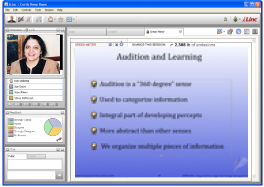
1. You will get an email about a week before the workshop, giving you a link to click. On the appointed day and time, you click the link to enter the online classroom. Sign in with your name and email address. A Java applet will be downloaded and run. You will then enter the online classroom with the password provided.

2. The participants can always see and hear the presenter, but a participant can be heard by everyone only when she has the floor. So, if you have a question and let the presenter know it, she will give you the floor. Most participants prefer instead to use the text chat box (see next item).

3. The way to let the presenter know you have a question is to use the text chat window, which is always open. Type a message such as "Repeat that, please!" or "Can you please go over the technique one more time?" or "I have a question!" Often participants simply type in their questions in the chat window so as not to interrupt the flow of the presentation. The presenter will respond to all the questions appropriately.

4. Unless you have the floor, your mic will be muted; so, you don't have to worry that your cough or conversation will accidentally get broadcast.

5. You will see whatever the presenter presents: slides, videoclips, etc. -- just like a traditional presentation.

As a registrant, you will have an opportunity to experience a "dry run" of the online classroom before the workshop, to ensure you are set up correctly.

What are the Equipment Requirements?

1. You need a fast broadband internet connection (DSL, Cable, etc.). A dial-up connection won't do. Sometimes, the total bandwidth of a school system is shared by so many employees using the internet, you may not have adequate bandwidth for live audio/video streaming; consequently, you may experience inconsistent audio quality. If you have the option of attending this workshop from home and you have a good broadband internet connection, we recommend you do that.

2. You need a PC (running Windows XP-SP2, Windows Vista, or Windows 7) or a Mac (running OS 10.5 or above) that can handle the teleconferencing needs of this workshop. Generally, if you have a relatively new computer (2-3 years old), you should be okay. If you are able to watch hi-def videos on the internet (here is a short HD video from Vimeo that you can try), your computer and internet connection probably have what it takes. {If you have a Mac, make sure it is an Intel Mac -- e.g., MacBook, MacBookPro, etc. The very old PowerPC Macs, such as the Powerbook won't do}

You can also click on this link to test your system at our teleconferencing site itself!

3. You need a USB headset plugged into a USB port. Without the headset, the sound will output through your speakers and be fed back into your microphone! (In some cases, you can use open speakers if you turn off your microphone or don't have a microphone attached. Make sure you are in a private, quiet area if you are going to turn up open speakers.)

A couple of weeks before your workshop, we will send you a cheat sheet to help you adjust your systems settings for the microphone, speaker, etc. However, it is your responsibility to ensure that you have the proper setup from your side.

Don't worry, all registrants will have the opportunity to log into the online classroom for a brief, unassisted "dry run" before the actual workshop to make sure they have the right gear. This will only take a few minutes and can alert you to any problems with your set up ahead of time.

What If I Get Disconnected During the Workshop?

No problem. Simply click the link that you used to get to the online classroom the first time to get back on. The same strategy works if your screen freezes up (which can happen occasionally, if you have a slow connection). Simply exit the classroom, and log back in.

Can More than One Person Share A Computer?

No. Each participant must register and should have her (his) own computer, webcam and headset -- except, in cases, where the school system has set up its teleconferencing facilities for this purpose. All attendees must be individually registered. Please note that the registration fee is per attendee.

What About Handouts and Other Workshop Material?

All hand-outs will be emailed to you before the workshop. You will need to print and keep them for reference during the workshop.

Can I Register for Part of the Day?

No.

Are There Group Rates?

No. The registration fee is per attendee and must be paid even if you attend as a group. If you have a large group and prefer to register them together, you may collect the registration information for each of them and send it in a single email to workshops{at}smart-ears.com.

Will I Get A Certificate?

Yes. When you return your completed course feedback and evaluation form, we will email you a workshop completion certificate (usually within a week). Each workshop provides a specified number of professional development hours. Since the procedures and requirements vary from field to field (Teachers, SLPs, etc) and from state to state, you will have to contact your state for the specific procedure for your state. You can attach the workshop completion certificate and the workshop agenda for documentation. For ASHA CEUs, see below.

CEUs

Our workshops offer ASHA CEUs. See the web page for each workshop for the number of CEUs it provides.
1. The CEUs are given for completing the course. Partial credit is not given for partial attendance.
2. In order to receive the ASHA CEUs, participants must complete and return a) the course feedback and evaluation form, and b) the ASHA participant CEU form to reach us within 15 days of the workshop. (The forms, along with instructions, will be emailed to the participants prior to the workshop).
3. Please do not send us the ASHA CE Registry fee. This fee is paid by the participant directly to the ASHA national office.

Our workshops are also approved by the AG Bell Academy for Listening and Spoken Language and provide CE hours to LSLS certified professionals; LSLS candidates can use the hours towards some of the learning hours. Contact AG Bell Academy for details. After the workshop, the attendees are sent an LSLS form which they should complete and keep (i.e., not return to us), to be used when they need to document the CE/learning hours.

What is the Cancellation Policy?

If you cancel more than 7 days prior to the workshop, your registration fee will be refunded or credited toward a future workshop at your option. If you cancel within 7 days of the workshop, your fee will be credited toward a future workshop. No refund or credit will be given to no-shows (those who simply fail to turn up).

In the unlikely event of the workshop being canceled, your fee will be refunded or credited toward a future workshop at your option.

Grievance Resolution Policy

If you have a complaint or grievance about any aspect of your participation in one of our workshops, please send an email to workshops@smart-ears.com detailing your experience and attaching any previous communications you have had in resolving the problem. We will investigate and reach a resolution in consultation with you, and communicate it to you within 30 days of receiving your complaint. Our objective is to serve you by providing value in the form of our workshops and we will try to help any way we can. Some issues, though, are beyond our control (e.g., if the equipment or internet connection at your end is inadequate). Please note that our maximum liability cannot exceed the registration fee that we received from the participant.

Do I Need A Webcam? Can I Just Use the Audio?

A webcam is not necessary. A headset is invaluable because using open mic and speakers could result in audio feedback loop problem which will not only affect you but every participant. In some cases, it is possible to use open speakers (and disable your microphone), especially if you are in a quiet, private room.

I Work with Middle/High School HI Students ..............

This workshop focuses on working with 0-8 age group. Issues relating to older children will not be discussed.

I Work in a TC Program; Is This Workshop for Me?

If developing spoken language through audition is a part of your Total Communication program objectives, you will find the techniques taught in this workshop very useful.

I am a Student; Can I Attend This Workshop?

Yes. It is strongly recommended that you attend the BASICS Workshop before taking advanced level workshops.

OK, How Do I Register?

Click on "Click Here to Register" on the workshop web page. Fill out the registration form and click 'Submit'. You will receive a confirmation email within 48 hours, telling you how to pay (or send a purchase order, if your school/employer is paying). Once we receive your payment, your registration will be complete.

I Have More Questions!

Click "Contact Me" at the bottom of this page to send an email. ( Or write to workshops{at}smart-ears.com )